Student Loan Repayment Plans in 2026 — Which Plan Fits Your Income Now


In this guide
SAVE is over — a federal court order ended it in March 2026 — and millions of former SAVE borrowers must pick a new plan or be placed on one. The wrong choice costs thousands: the same $40,000 loan costs $451.96 a month on one plan and $300.50 on another, and the cheaper payment can cost about $15,577 more overall. One date decides your options: 1 July 2026. All figures checked 14 November 2026.
Photo: The degree is done — now the repayment plan decides what the loan costs you every month. (Photo: Pexels)
What You Will Learn
- Which side of the 1 July 2026 line your loans fall on
- What each plan charges, in dollars
- The $40,000 worked example
- Which plan fits your life
- How to apply free and recertify yearly
- The traps to avoid
Step 1: Find your dividing line — check every loan’s disbursement date
What to do: Check the disbursement date of every federal loan you hold on StudentAid.gov — before comparing any plan.
How: Federal Student Aid says the plans open to you depend on your loan types and the dates they were first paid out. Your Dashboard, under “My Loans,” shows each loan’s type, balance, rate and plan. Loans disbursed on or after 1 July 2026: only RAP is available as an income-driven plan. Loans from before that date: several plans, including RAP. With a mix, your loans may sit on two different plans — check each one.
Example: You borrowed $25,000 in 2023 and $15,000 in September 2026. The 2023 loans can use IBR, PAYE, ICR or RAP; the 2026 loan only RAP or Tiered Standard.
Common mistake: Assuming all your loans follow the same rules. The date is per loan, not per borrower.
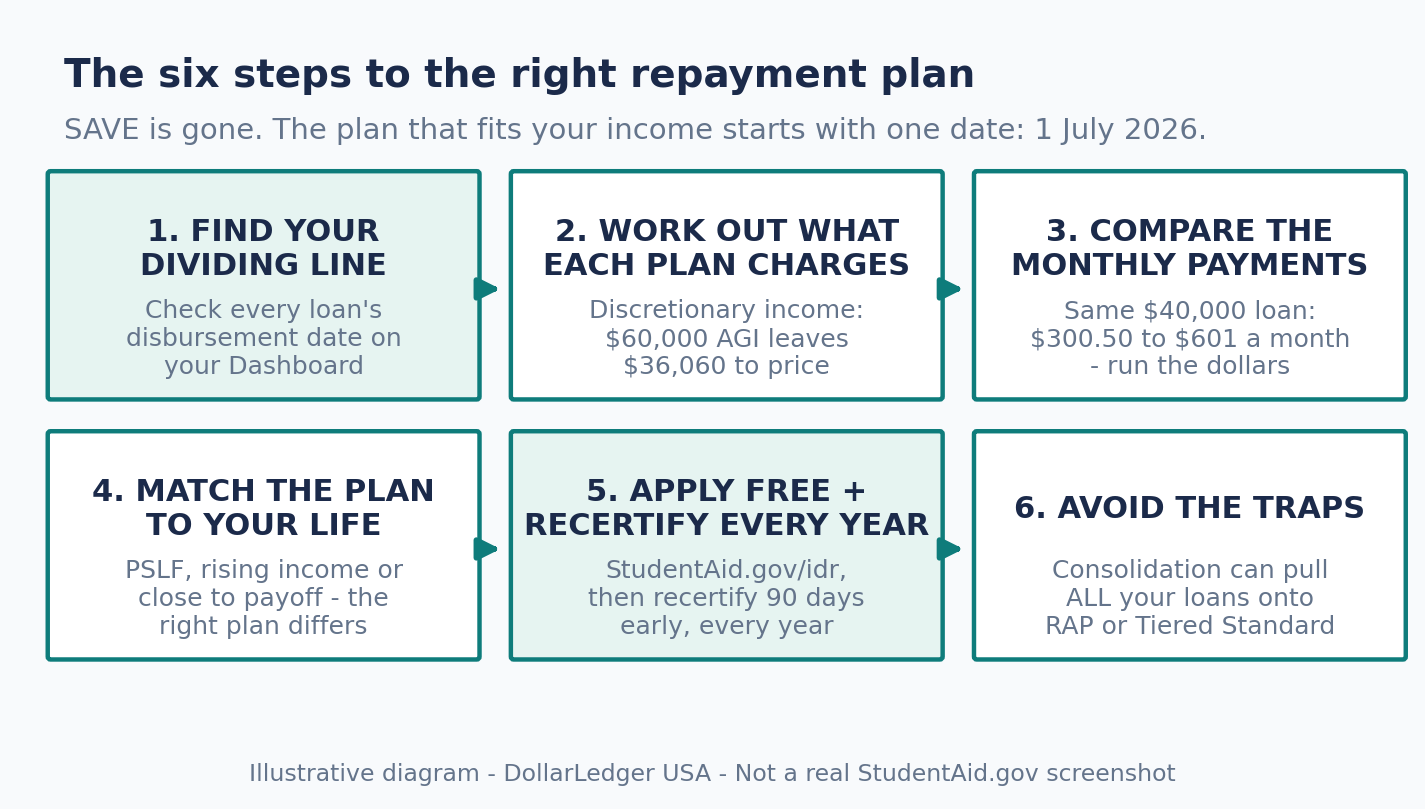
Illustrative diagram - The six steps to the right student loan repayment plan. NOT a real StudentAid.gov screenshot.
Step 2: Work out what each plan actually charges — the dollars behind the percentages
What to do: Learn the two formulas: discretionary income, and AGI for RAP.
How: IBR, PAYE and ICR use discretionary income: AGI minus 150% of the poverty guideline. Single in 2026, the guideline is $15,960, so $23,940 is protected. On $60,000, discretionary income is $36,060. IBR charges 15% for older borrowers and 10% for new borrowers (first loan on or after 1 July 2014); PAYE 10%; ICR the lower of 20% or an income-adjusted 12-year payment. RAP charges 1–10% of full AGI, minus $50 a month per dependent, never below $10 — and pays an interest subsidy when full, on-time payments fall short of the interest.
Example: On $60,000 with no dependents, new-borrower IBR is 10% of $36,060 ÷ 12 — $300.50 a month. RAP runs $50–$500; with two dependents, $10–$400.
Common mistake: Comparing percentages, not dollars: 10% of discretionary income is $300.50, not $500.
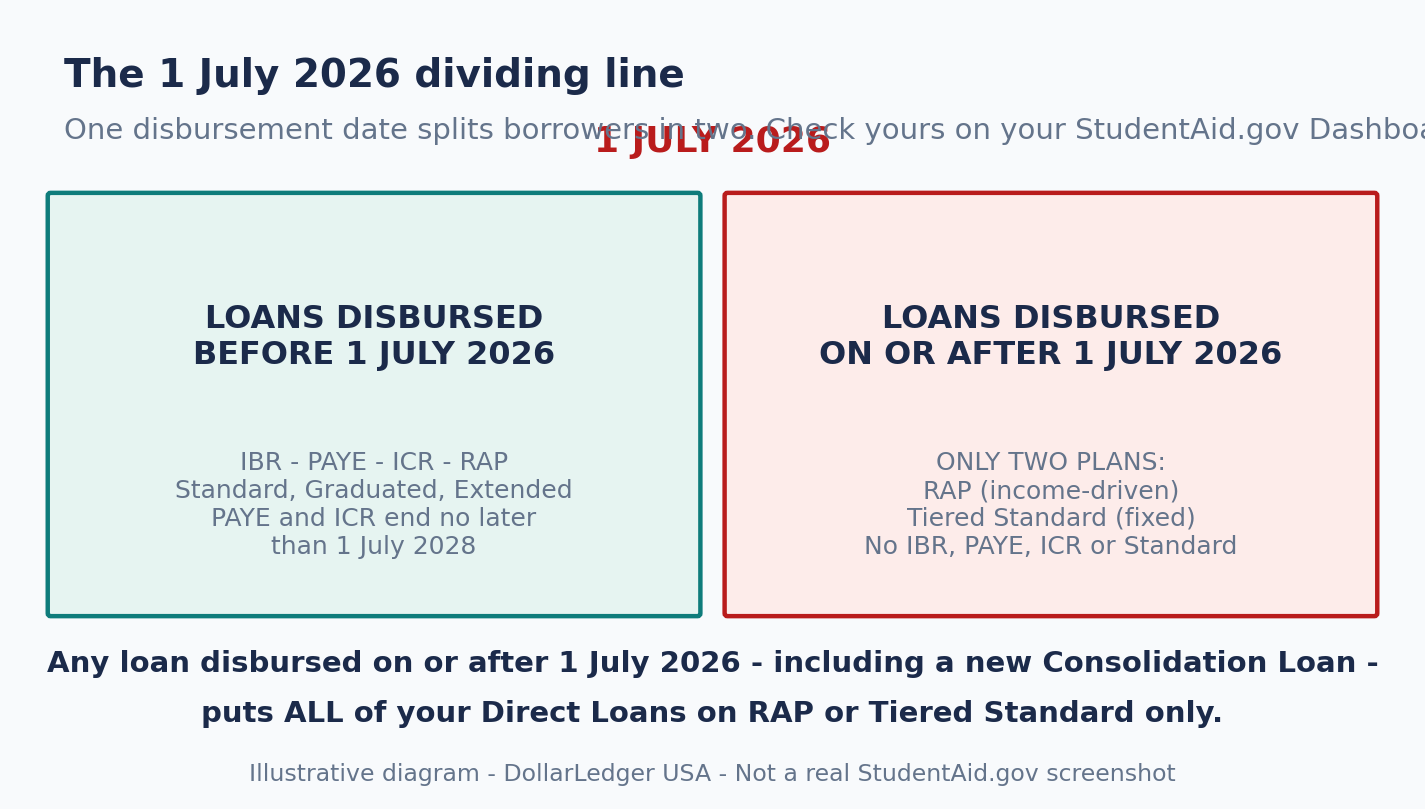
Illustrative diagram - One disbursement date splits borrowers in two. NOT a real StudentAid.gov screenshot.

Photo: Price every plan in dollars before you choose — the percentages hide the real difference. (Photo: Pexels)
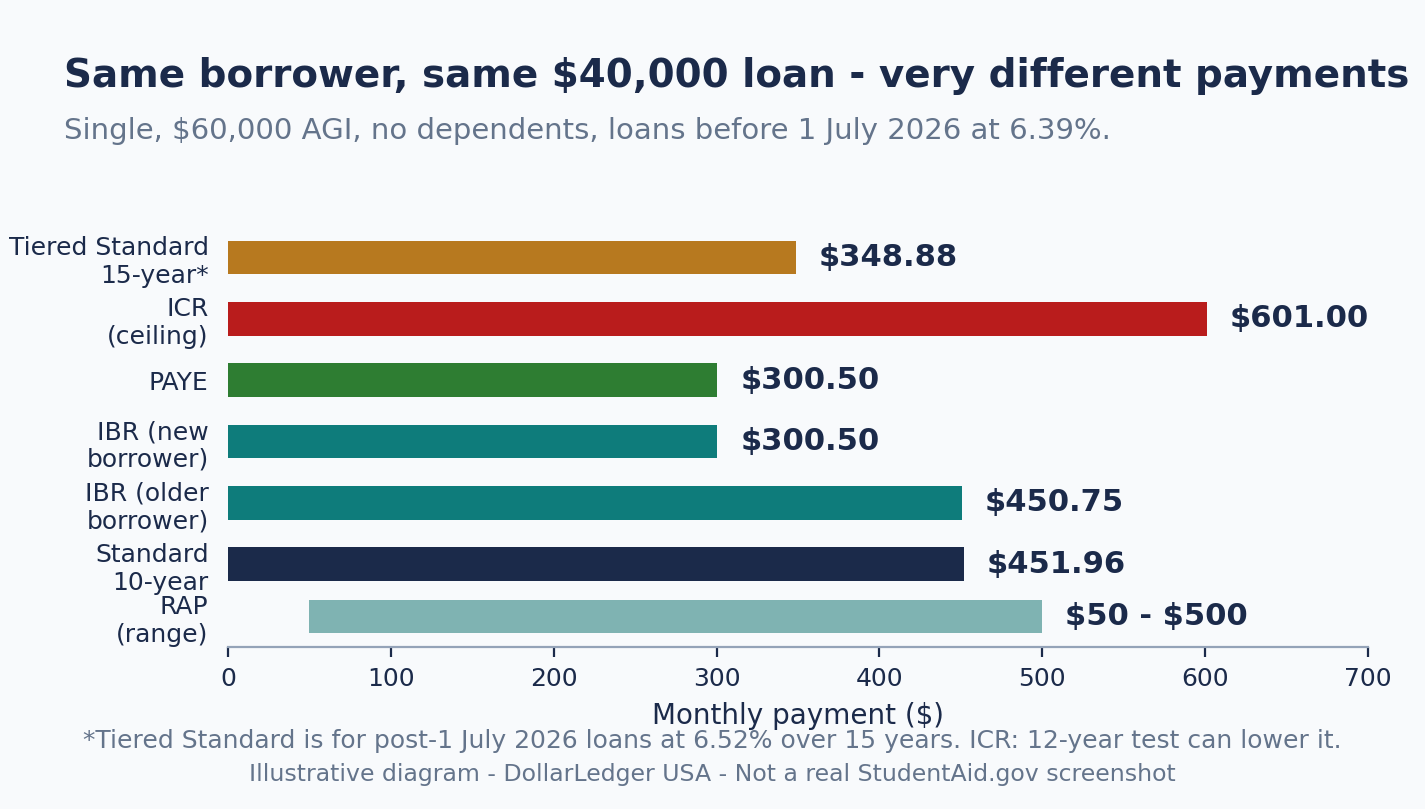
Illustrative diagram - Same borrower, same $40,000 loan: payments from $50 to $601 a month. NOT a real StudentAid.gov screenshot.
Step 3: Compare the payments on one borrower — the $40,000 worked example
What to do: Run every plan on the same borrower and loan.
How: Single borrower, $60,000, no dependents, $40,000 of Direct Loans from before 1 July 2026 at 6.39% (the 2025–26 undergraduate rate). Standard 10-year: $451.96 a month, $54,234.76 total, $14,234.76 of it interest. IBR, older borrower: $450.75 a month, about 121 months, $54,293.01 — nearly identical to Standard. IBR, new borrower, and PAYE: $300.50 a month; if income never rose, 233 months and $69,811.60 — $15,576.84 more. ICR: at most $601.00 a month, and the 12-year test can only lower it. RAP: $50–$500 a month here. Tiered Standard — the only fixed option for post-1-July-2026 loans — runs 10 to 25 years by balance; on $40,000 that is 15 years, about $348.88 a month at 6.52%, $62,798.92 total.
Example: IBR at $300.50 instead of Standard at $451.96 saves $151.46 a month — but costs $15,576.84 more if income stays flat. Rising income shrinks the gap.
Common mistake: Choosing the lowest monthly payment without counting the total.
Step 4: Match the plan to your life — PSLF, rising income, or close to payoff
What to do: Pick from your situation, not a ranking.
How: Chasing PSLF? You need an income-driven plan: most IDR payments count toward PSLF if you meet the other requirements — see who qualifies for forgiveness now. A fixed plan is not an IDR plan — do not assume its payments count. Income low now but rising? New-borrower IBR caps your payment at the Standard amount. Close to payoff, or earning enough that IDR nearly equals Standard? Take Standard — cheapest, done in ten years. All loans from on or after 1 July 2026? Only RAP or Tiered Standard: RAP if income is low next to the balance, Tiered Standard for a fixed payment and a definite end date. Parent PLUS borrowers have no IDR option — only Tiered Standard. Defaulted loans qualify for no IDR plan until the default is resolved.
Example: A teacher on $48,000 with $55,000 of pre-2026 loans belongs on IBR or RAP; an engineer on $110,000 with $18,000 left belongs on Standard.
Common mistake: Copying someone else’s plan — income, employer and payoff date decide.
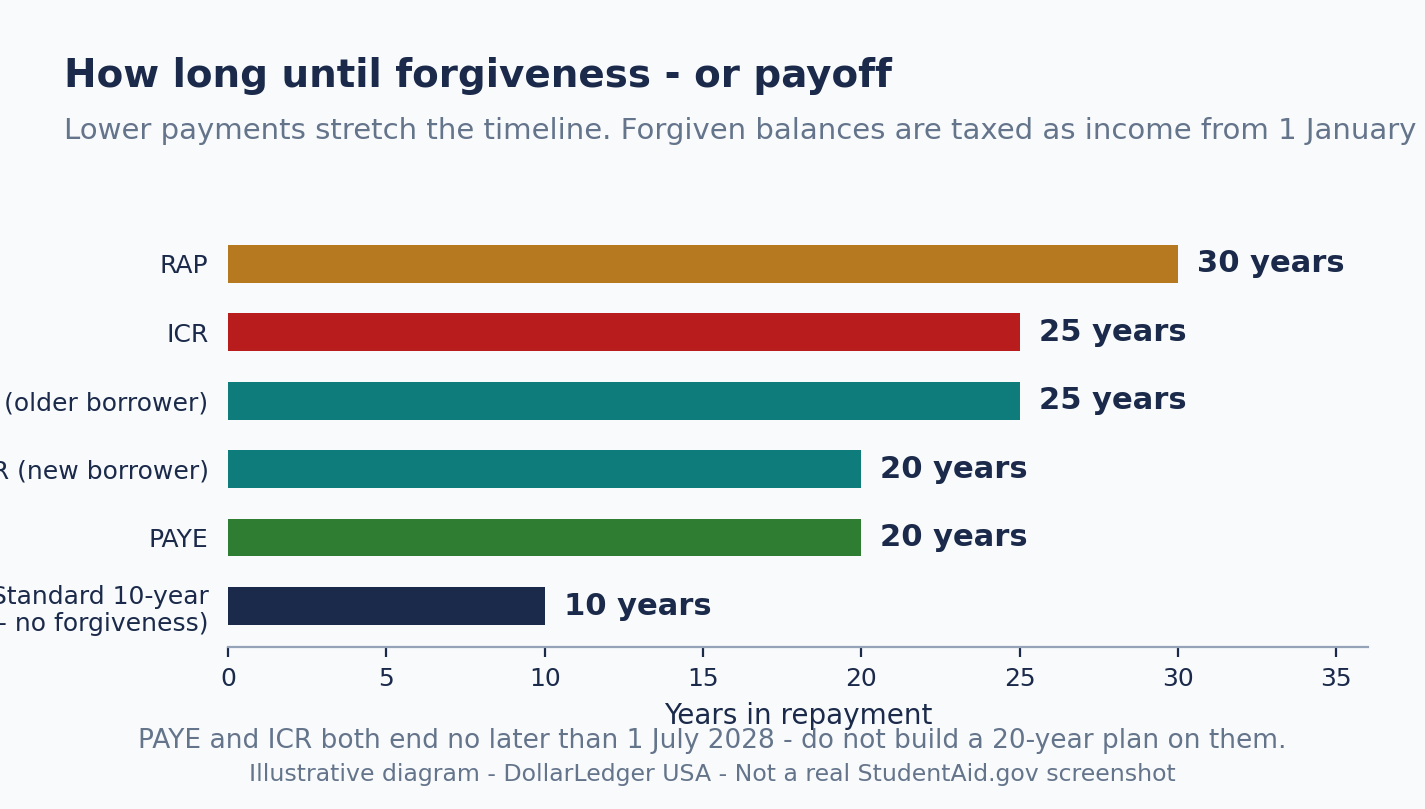
Illustrative diagram - Lower payments stretch the timeline to forgiveness. NOT a real StudentAid.gov screenshot.

Photo: Your plan is a personal choice — income, employer and payoff date matter more than any ranking. (Photo: Pexels)
Step 5: Apply for free — and recertify every year, on time
What to do: Apply through the official channel only, and diary your recertification date. Nobody should ever charge you for this.
How: Applying is free: file an IDR Plan Request at StudentAid.gov/idr, or send the form and income documents to your servicer. Consenting to IRS tax-data sharing is fastest — and sets up automatic recertification. Recertify once a year, ideally 90 days before your date, shown on your Dashboard under “My Loans.” Miss it and your payment stops being income-based and can jump. If income or family size changes mid-year, ask for a recalculation instead of waiting. While an application is processed, your servicer may use processing forbearance of up to 60 days. Auto pay brings a 1% rate reduction from 1 July 2026 if you enrol by 31 December 2026, through 30 June 2028.
Example: Recertification due 15 March 2027? Submit by mid-December 2026, with autorecertification switched on.
Common mistake: Treating enrolment as a one-time job — the plan only stays income-based if you recertify.
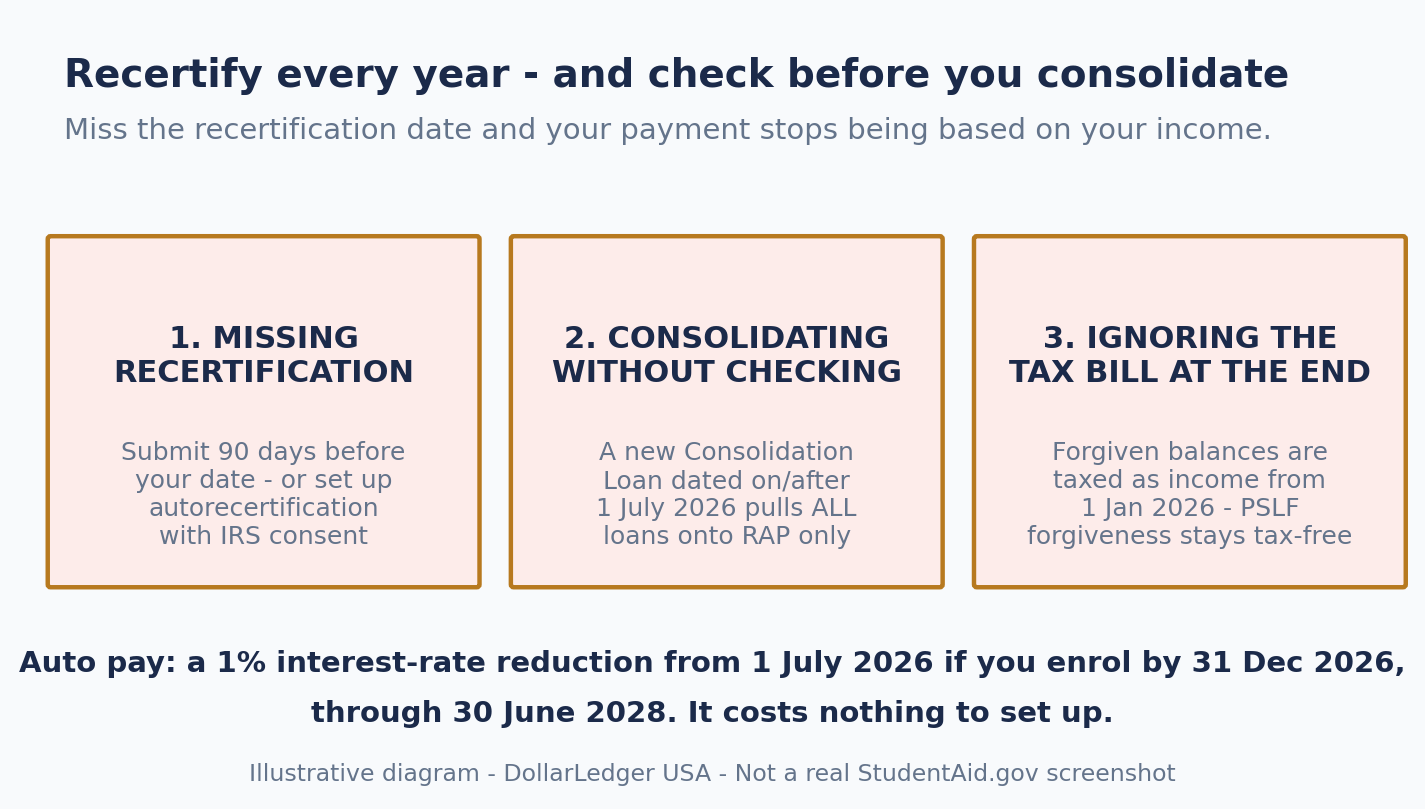
Illustrative diagram - Recertify every year, and check before you consolidate. NOT a real StudentAid.gov screenshot.
Step 6: Avoid the three traps — consolidation, leaving PAYE or ICR, and the tax bill
What to do: Check these three before you sign — each is hard to undo.
How: First, consolidation: a new loan with a new disbursement date, and new repayment options. If any loan is disbursed on or after 1 July 2026, including a new Consolidation Loan, only RAP and Tiered Standard apply to all your Direct Loans. Second, PAYE and ICR. Both end no later than 1 July 2028, and enrolment has been restricted since July 2024 — the last enrolment date has moved more than once, so do not build a 20-year plan on either. Already on PAYE or ICR? Think twice before switching out — you may not get back in. Third, the tax bill. A balance discharged at the end of an IDR period is taxed as income if the last payment falls on or after 1 January 2026 — while PSLF forgiveness stays free of federal tax. SAVE forbearance time does not count toward PSLF or IDR forgiveness.
Example: On PAYE since 2022? The switch to IBR may be one-way — run the Loan Simulator first.
Common mistake: Consolidating to “simplify” without checking the date — one new loan can move every loan you own.
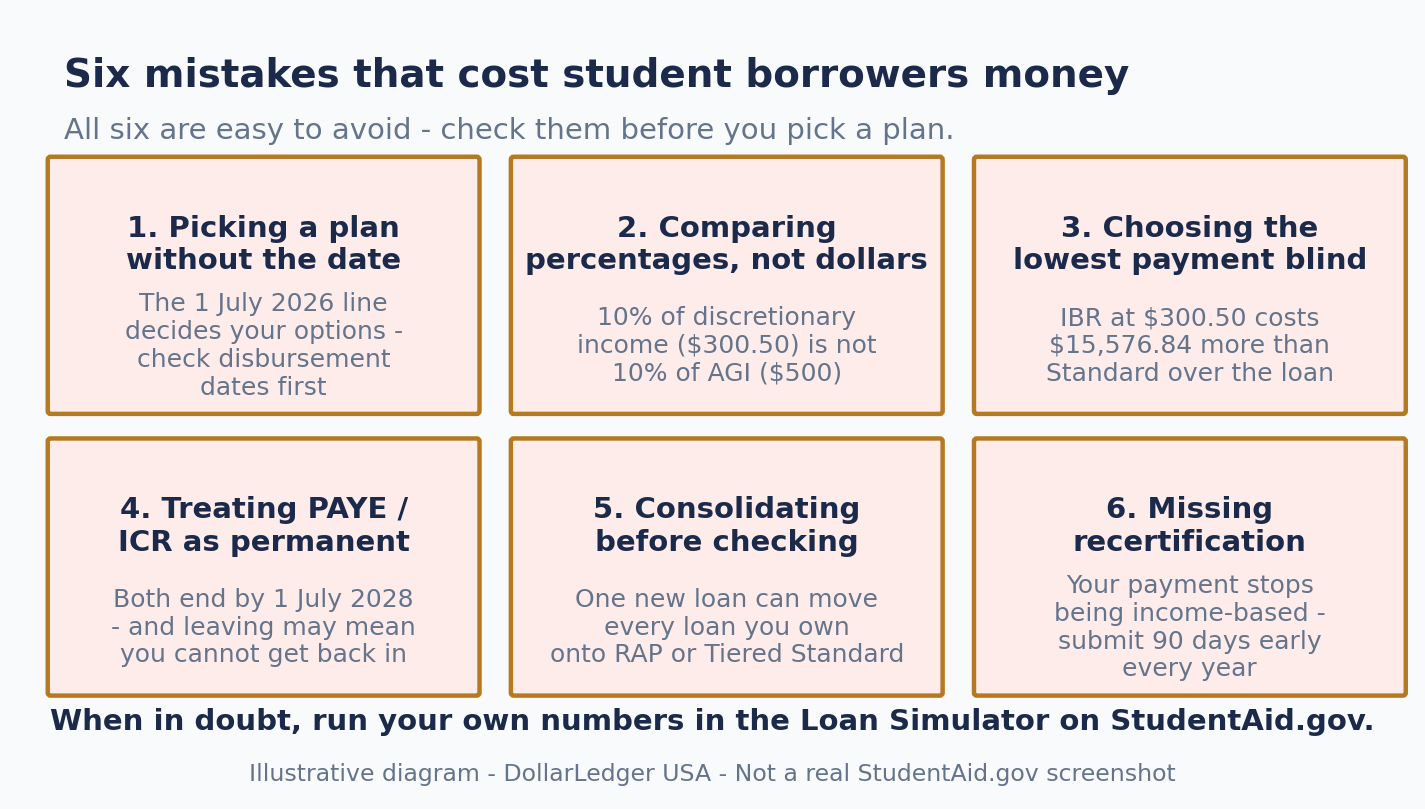
Illustrative diagram - Six mistakes that cost student borrowers money. NOT a real StudentAid.gov screenshot.
Checklist
- Every loan’s disbursement date checked on your Dashboard.
- Your side of the 1 July 2026 line identified.
- Discretionary income worked out ($23,940 protected for a single borrower).
- Each plan priced in dollars on your income.
- Plan matched to your life.
- IDR application sent free; recertification date in your calendar.
- Consolidation, PAYE/ICR exit and the tax bill checked first.
FAQ
I have loans from before and after 1 July 2026 — what happens?
They can sit on two plans — and the newer loan limits the older ones: any loan disbursed on or after 1 July 2026 leaves only RAP and Tiered Standard for all your Direct Loans. Check each loan’s date and run the Loan Simulator first.
Is the SAVE plan really gone?
Yes — a court order ended SAVE in March 2026. Servicers began sending notices on 1 July 2026 giving borrowers 90 days to choose; miss the deadline and you are auto-enrolled in Standard — or Tiered Standard if you hold a post-1-July-2026 loan.
What is discretionary income, exactly?
AGI minus 150% of the poverty guideline. Single in 2026: the guideline is $15,960, so $23,940 is protected. On $60,000, discretionary income is $36,060, and new-borrower IBR charges 10% — $300.50 a month. RAP charges 1–10% of full AGI instead.
Will the balance forgiven at the end be taxed?
If the last payment of your IDR period falls on or after 1 January 2026, the discharged balance is taxed as income federally, and likely by your state too. PSLF forgiveness is not taxed federally — but a $30,000 discharge can add thousands to one tax return.
Sources
- Federal Student Aid, Top FAQs About Income-Driven Repayment Plans (opened live 14 November 2026): https://studentaid.gov/articles/faqs-idr-plan/
- Federal Student Aid, SAVE Plan Borrowers: FAQs About Choosing a Different Repayment Plan (opened live 14 November 2026): https://studentaid.gov/articles/save/
All figures checked 14 November 2026 against Federal Student Aid. The $40,000 example is DollarLedger’s own arithmetic, assuming flat income — the Loan Simulator gives your exact numbers.
Disclaimer: For education only, not financial, tax or investment advice. Confirm your loans, dates and options on StudentAid.gov and with your servicer before you decide.